

Greek Cooking for Kids
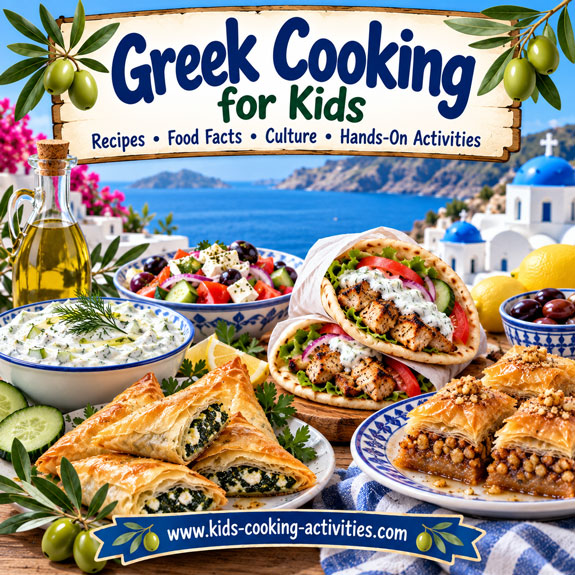
Explore Greek cooking for kids with traditional foods, easy recipes, geography activities and food facts about Greece. From olive oil, lemons and fresh vegetables to feta cheese, yogurt, herbs and flaky phyllo pastry, Greek cooking gives kids a delicious way to explore the people, places and food traditions of this Mediterranean country.
Greece includes a mountainous mainland and thousands of islands and is surrounded by the Aegean, Ionian and Mediterranean Seas. Geography, climate, agriculture and access to the sea have all helped shape the foods prepared in different parts of the country.
Explore Greece Through Cooking
Turn your Greek cooking day into a hands-on country study. Find Greece on a map, explore its mainland and islands, investigate Mediterranean ingredients, learn a few Greek words and prepare a recipe connected with Greek food traditions.
As kids cook, encourage them to notice how ingredients such as olive oil, lemons, vegetables, herbs, yogurt, cheese and grains are used in different dishes.
Greek cooking includes many regional and family traditions. Foods can change from the mountainous mainland to coastal areas and islands, and some dishes are also connected with the wider Mediterranean, Balkan and eastern Mediterranean regions. As you explore, look at where a food is prepared, which ingredients are available there and how neighboring food traditions sometimes overlap.
What Kids Will Learn
Cooking is a fun way to connect geography and culture with practical kitchen skills. During this Greek cooking study, kids can learn:
- Where Greece is located in Europe
- How the mainland and Greek islands are different
- How the Mediterranean climate can influence food
- Why olives and olive oil are important in Greek cooking
- Ingredients commonly used in Greek dishes
- How foods can vary between different parts of Greece
- A few useful words and phrases in Greek
- How Greek food connects with neighboring food traditions
- Cooking skills such as marinating, mixing, folding and assembling
- How to compare Greek foods with recipes from other countries
Kids Cooking Activities Teaching Materials
Teaching kids to cook? Save time with ready-made lesson plans used by parents and teachers. Browse teaching materials →


This page may contain affiliate links. We may earn a small commission at no extra cost to you. Learn more.
Greek Cooking Table of Contents
- What Kids Will Learn
- Explore Greece
- Greek Food Traditions
- Greek Ingredients to Explore
- Learn a Little Greek
- How Food Changes Across Greece
- Greek Recipes for Kids
- Easy Tzatziki
- Greek-Style Chicken or Pork Pitas
- Greek Spanakopita
- Greek Souvlaki
- Greek Baklava
- More Greek & Mediterranean-Inspired Recipes
- More Greek Foods to Explore
- Extend Your Greek Cooking Lesson
- World Studies Notebook
- Greek Cooking Questions
Explore Greece
Greece is a country in southeastern Europe. It sits at the southern end of the Balkan Peninsula and includes a mainland along with many inhabited and uninhabited islands.
The sea is an important part of Greek geography. Greece has an extensive coastline, and communities have developed on islands, along the coast, in fertile valleys and in mountainous areas. These different landscapes have helped create a variety of regional foods and cooking traditions.
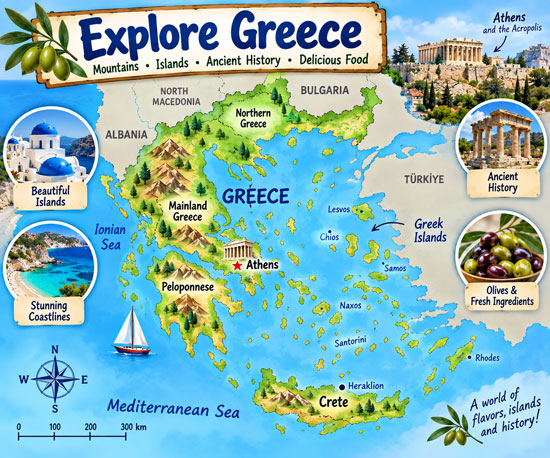
Locate Europe on a world map and then find Greece. Look for the mainland and some of the islands surrounding it. Find Athens, the Aegean Sea, Ionian Sea and Mediterranean Sea. Then locate nearby countries such as Albania, North Macedonia, Bulgaria and Türkey.
As you prepare Greek recipes, mark the foods on your map or World Studies notebook and record whether they are connected with a particular part of Greece.
Greece's geography helps make this country especially interesting to study through food. Mountainous areas, farming regions, coastal communities and islands do not all have exactly the same ingredients or traditions. Geography can influence what people grow, raise, catch and cook.
Greek Food Traditions
Greek cooking often makes flavorful dishes from relatively simple ingredients. Olive oil, vegetables, beans, grains, herbs, cheese, yogurt, lemons, seafood and meats all have places in Greek food traditions.
Fresh and seasonal ingredients are important in many dishes. Tomatoes, cucumbers, eggplant, zucchini, peppers and leafy greens can appear in salads, baked dishes, pies and vegetable meals. Beans and lentils are used in soups and other filling dishes, while grains and flour become breads, pastries and pies.
Herbs such as oregano, dill, mint and parsley can add plenty of flavor without making food spicy. Lemon and olive oil are also frequently used to season vegetables, meats and other foods.
Meze are small dishes or appetizers that may be served together and shared. Depending on the meal, these might include olives, cheese, vegetables, dips, breads or other small foods. Instead of thinking of meze as one particular recipe, think of it as a way to serve and enjoy a variety of foods.
Greek Ingredients to Explore
Choose a few ingredients to examine before cooking. Kids can smell herbs, compare textures, find ingredients on a map or investigate how they are grown.
Choose olives, lemons, oregano, feta, yogurt or another Greek ingredient. Find out where it comes from, how it is produced and how it is used in Greek cooking. Then look for another country in your World Cooking study that uses the same ingredient.
Learn a Little Greek
Greek is the official language of Greece and uses its own alphabet. Try learning a few simple words and phrases before beginning your cooking activity.
Choose one Greek word to practice while you cook. You can also look at the Greek alphabet and see how Greek words are written differently from English words.
How Food Changes Across Greece
Greece may be one country, but its food traditions can change from one region to another. Mountains, farmland, islands, coastlines and local growing conditions all influence the ingredients people have traditionally used.
As kids explore Greek cooking, encourage them to look beyond individual recipes and ask: Where in Greece might these ingredients be available? What grows there? Is the area near the sea? What foods are produced locally?
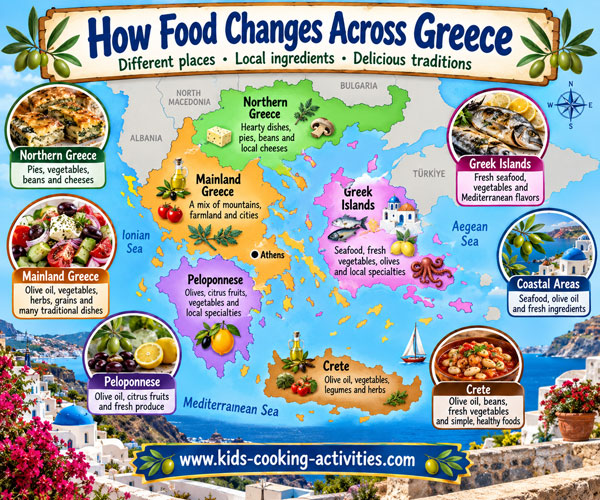
Choose one place on mainland Greece and one Greek island. Find both on a map and compare their geography. Are they mountainous? Near the sea? What foods are grown or produced there? This helps kids see why there isn't just one way to describe Greek cooking.
On a map of Greece, add small pictures or words for foods and ingredients as you learn about them. You might add olives, lemons, grapes, cheese, herbs, vegetables, fish, breads or pies. Instead of trying to assign every food to one exact location, use the activity to notice how geography and local agriculture can influence cooking.
Greek Recipes for Kids
Now bring your Greece study into the kitchen. These recipes introduce kids to several ingredients and cooking techniques found in Greek food traditions, including olive oil, lemon, oregano, yogurt, feta cheese, spinach and phyllo pastry.
Some of these foods have variations throughout Greece and neighboring regions. Recipes also change from family to family, so use them as a starting point for exploring rather than as the only way a dish can be prepared.
Where Should We Start?
For a fresh dish: Try Greek Salad.
For hands-on cooking: Fold Greek Spanakopita.
For a family meal: Make Greek-Style Chicken or Pork Pitas or Greek Souvlaki.
For a baking challenge: Try Greek Baklava and learn how to work with layers of phyllo pastry.
Fresh Foods, Dips & Salads
Easy Tzatziki
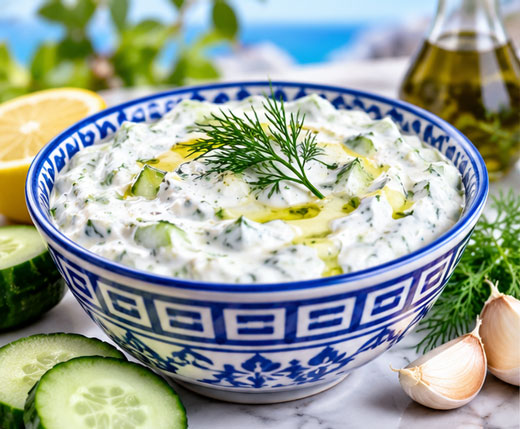
Tzatziki is a cool yogurt-and-cucumber dip or sauce associated with Greek cooking. It is an easy recipe for kids because there is no stove or oven involved. Serve it with pita bread, vegetables or alongside souvlaki and other savory dishes.

Ingredients
- 1 cup plain Greek yogurt
- 1/2 cucumber
- 1 small garlic clove, minced
- 1 tablespoon olive oil
- 1 tablespoon fresh lemon juice
- 1 tablespoon chopped fresh dill
- Pinch of salt
Directions
- Grate the cucumber.
- Place the grated cucumber in a clean kitchen towel or several layers of paper towel and gently squeeze out as much extra liquid as possible.
- Add the Greek yogurt to a bowl.
- Stir in the cucumber, garlic, olive oil, lemon juice, dill and a small pinch of salt.
- Mix until well combined.
- Cover and refrigerate for at least 30 minutes so the flavors can blend.
- Stir again before serving.
Kid-Friendly Tip: Kids can measure the yogurt, squeeze the lemon and stir the ingredients together. An adult can help younger children grate the cucumber and mince the garlic.
Yogurt, cucumber, olive oil, garlic and herbs are all useful ingredients to investigate during a Greek food study. Taste a small amount of plain yogurt before making the tzatziki, then taste the finished dip and notice how the cucumber, lemon, garlic and dill change its flavor.
Pitas, Pies & Handheld Foods
Greek-Style Chicken or Pork Pitas
These Greek-style chicken or pork pitas are filled with meat marinated in olive oil, lemon, garlic, mustard and oregano, then topped with a cool yogurt-and-cucumber sauce.
This is a useful recipe for teaching kids how a marinade adds flavor before food is cooked.
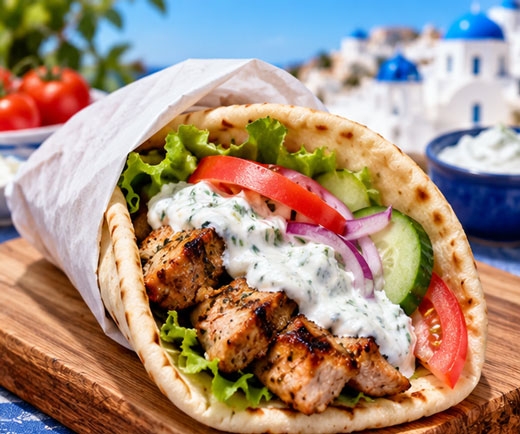
Chicken or Pork
- 1 pound pork loin or boneless skinless chicken breasts, cut into cubes or strips
- 1/4 cup olive oil
- 1/4 cup lemon juice
- 1 tablespoon mustard
- 2 cloves garlic, minced
- 1 teaspoon dried oregano
- Salt and black pepper, to taste
- Pita bread, for serving
Cucumber Yogurt Sauce
- 1 cup plain Greek yogurt
- 1/2 cucumber, grated and squeezed dry
- 1 small garlic clove, minced
- 1/2 teaspoon dried dill or 1 tablespoon chopped fresh dill
- Pinch of salt
Directions
- In a bowl or resealable food-storage bag, combine the olive oil, lemon juice, mustard, garlic, oregano, salt and pepper.
- Add the chicken or pork and turn the pieces until they are coated with the marinade.
- Cover or seal and refrigerate for at least 1 hour or up to several hours.
- While the meat marinates, combine the yogurt, cucumber, garlic, dill and salt in a small bowl.
- Cover the sauce and refrigerate until serving time.
- Adult Step: Cook the marinated meat in a skillet, on a grill or using another appropriate cooking method until completely cooked. Chicken should reach an internal temperature of 165F (74C). Pork should reach at least 145°F (63°C) followed by a 3-minute rest.
- Warm the pita bread if desired.
- Fill each pita with cooked meat and spoon the cucumber yogurt sauce over the top.
- Add chopped tomato, lettuce, cucumber or onion if desired.
Kid-Friendly Tip: Kids can whisk the marinade, measure ingredients and assemble their own pitas. Keep utensils and surfaces that touch raw meat separate from ready-to-eat ingredients.
Set out the cooked meat, pita bread, tzatziki or cucumber yogurt sauce, tomatoes, cucumbers and other toppings. Let each child build a pita and compare the flavors and textures they chose.
Easy Greek Spanakopita Triangles
Spanakopita is a Greek savory pie made with spinach, cheese and flaky phyllo pastry. It can be prepared as one large pie or folded into smaller individual pieces. This kid-friendly version makes small triangles that are fun for kids to help fill and fold.
Working with phyllo also introduces a new cooking skill. The paper-thin sheets can dry out quickly, so keep the unused pastry covered with a slightly damp clean kitchen towel while you work.
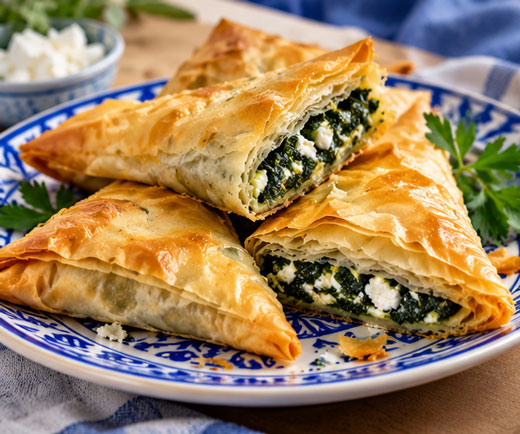
Ingredients
- 1 medium onion, finely chopped
- 2 tablespoons olive oil
- 1 (10-ounce) package frozen chopped spinach, thawed
- 8 ounces feta cheese, crumbled
- 6 ounces cottage cheese
- 2 eggs, lightly beaten
- 1/4 cup breadcrumbs
- 8 ounces phyllo pastry, thawed according to package directions
- 1/2 cup butter, melted
Directions
- Preheat the oven to 375F (190C). Line a baking sheet with parchment paper.
- Squeeze as much liquid as possible from the thawed spinach. Removing the extra moisture helps keep the pastry crisp.
- Adult Step: Heat the olive oil in a skillet over medium heat. Add the onion and cook until softened.
- Add the spinach and cook for another 2 to 3 minutes. Remove from the heat and allow the mixture to cool slightly.
- In a large bowl, crumble the feta cheese.
- Add the cottage cheese, eggs and breadcrumbs.
- Stir in the cooled spinach and onion mixture until combined.
- Unroll the phyllo pastry. Keep the sheets you are not using covered with a slightly damp clean kitchen towel so they do not dry out.
- Place one sheet of phyllo on a clean work surface and lightly brush it with melted butter.
- Place another sheet on top and brush lightly with butter again.
- Cut the layered phyllo lengthwise into strips about 3 inches wide.
- Place a spoonful of spinach filling near the bottom of one strip.
- Fold one bottom corner diagonally over the filling to form a triangle.
- Continue folding the triangle up the strip, similar to folding a flag, until you reach the end.
- Place the triangle seam-side down on the prepared baking sheet.
- Repeat with the remaining phyllo and filling.
- Lightly brush the tops with melted butter.
- Bake for about 20 to 25 minutes, or until the phyllo is crisp and golden brown and the filling is hot.
- Allow the spanakopita to cool for several minutes before serving.
Kid-Friendly Tip: Kids can crumble the feta, stir the filling and help fold the phyllo triangles. Phyllo tears easily, but don't worry if a sheet develops a small tear-another layer can usually cover it.
Phyllo is an extremely thin pastry dough used in Greek cooking and in foods from several neighboring regions. Instead of one thick piece of dough, many delicate sheets are layered together with butter or oil to create a light, crisp texture when baked.
Spinach pie is only one kind of Greek savory pie. Different pies may contain cheese, greens, vegetables, meat or other fillings. Look for another Greek pie and compare its filling with spanakopita.
Grilled & Family Meal Ideas
Greek Pork Souvlaki
Souvlaki is a Greek dish made with small pieces of meat cooked on skewers. Pork is a common choice in Greece, although other meats may also be used.
This version uses a simple marinade of olive oil, lemon, garlic and oregano. Serve the cooked souvlaki with pita bread, tzatziki, salad or vegetables for an easy family meal.
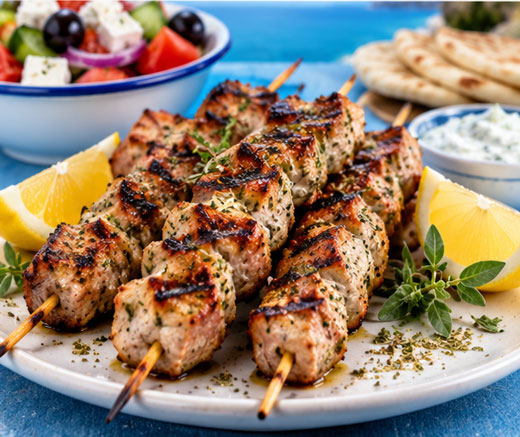
Ingredients
- 2 pounds pork tenderloin, cut into 1-inch cubes
- 1/4 cup olive oil
- 1/4 cup fresh lemon juice
- 3 cloves garlic, minced
- 2 teaspoons dried oregano
- 1 teaspoon salt
- 1/2 teaspoon black pepper
- Wooden or metal skewers
- Lemon wedges, for serving, optional
- Pita bread and tzatziki, for serving, optional
Directions
- If using wooden skewers, soak them in water for at least 30 minutes before cooking.
- In a bowl or resealable food-storage bag, combine the olive oil, lemon juice, garlic, oregano, salt and black pepper.
- Add the pork cubes and turn until they are evenly coated.
- Cover or seal and refrigerate for at least 1 hour or up to several hours.
- Remove the pork from the marinade and discard the leftover marinade.
- Thread the pork pieces onto the skewers, leaving a little space between the pieces so they cook evenly.
- Adult Step: Grill the skewers over medium-high heat, turning occasionally, until the pork is browned and reaches an internal temperature of at least 145F (63C).
- Remove the skewers from the grill and allow the pork to rest for at least 3 minutes.
- Serve with lemon wedges, pita bread and tzatziki if desired.
Kid-Friendly Tip: Kids can measure and whisk the marinade. Older children can help thread the pork onto skewers with close adult supervision. Always wash hands and work surfaces after handling raw meat.
These names describe different foods. Souvlaki generally refers to small pieces of meat cooked on a skewer. Gyro refers to meat traditionally cooked on a vertical rotating spit and sliced for serving. Both may be served with pita and similar toppings, which is why the names are sometimes confused.
Serve the souvlaki with Easy Tzatziki, pita bread and a Greek Salad. Ask kids to identify which ingredients appear in more than one part of the meal.
Greek Desserts & Baking
Greek-Style Walnut Baklava
Baklava is a rich layered pastry made with thin sheets of phyllo, nuts and a sweet syrup. It is enjoyed in Greece and is also part of food traditions across Türkiye, the Balkans, the Middle East and surrounding regions. Recipes vary in the nuts, spices and syrup used.
This Greek-style version layers walnuts and cinnamon between buttery sheets of phyllo and finishes the baked pastry with a simple honey-lemon syrup.
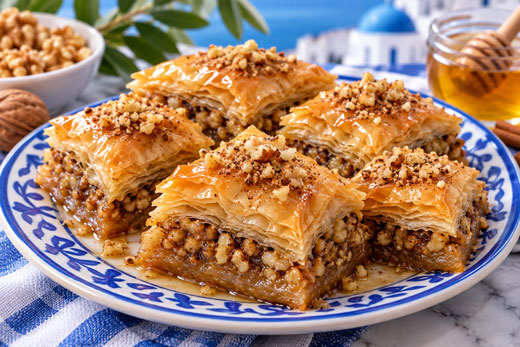
Ingredients
Baklava
- 1 package phyllo pastry, thawed according to package directions
- 2 cups finely chopped walnuts
- 1/4 cup sugar
- 1 teaspoon ground cinnamon
- 1 cup butter, melted
Honey-Lemon Syrup
- 1/2 cup sugar
- 1/2 cup water
- 1/4 cup honey
- 1/4 cup lemon juice
- 1/2 teaspoon vanilla extract
Make the Syrup
- Add the 1/2 cup sugar, water, honey and lemon juice to a small saucepan.
- Adult Step: Bring the mixture to a gentle boil, stirring until the sugar dissolves.
- Reduce the heat and simmer gently for about 5 minutes.
- Remove from the heat and stir in the vanilla.
- Set the syrup aside and allow it to cool while you prepare and bake the baklava.
Prepare the Baklava
- Preheat the oven to 325F (165C). Lightly grease a 9x13-inch baking dish.
- In a bowl, stir together the walnuts, 1/4 cup sugar and cinnamon.
- Unroll the phyllo pastry and trim the sheets to fit your baking dish if needed.
- Keep the phyllo you are not using covered with a slightly damp clean kitchen towel so it does not dry out.
- Place several sheets of phyllo in the bottom of the baking dish, brushing each sheet lightly with melted butter before adding the next.
- Sprinkle a thin layer of the walnut mixture over the phyllo.
- Add another few sheets of phyllo, brushing each one lightly with butter.
- Continue alternating layers of walnuts and buttered phyllo, finishing with several sheets of phyllo on top.
- Brush the top lightly with melted butter.
- Adult Step: Before baking, carefully cut the baklava into squares or diamonds using a sharp knife.
- Bake for about 45 to 55 minutes, or until the pastry is crisp and golden brown.
- Remove the hot baklava from the oven and carefully pour the cooled syrup evenly over the top.
- Allow the baklava to cool completely so the syrup can soak into the layers before serving.
Making the syrup first gives it time to cool while the baklava bakes. Pouring cooled syrup over the hot, freshly baked pastry helps the phyllo absorb the syrup while keeping its delicate layers crisp.
Kid-Friendly Tip: Kids can mix the walnuts, sugar and cinnamon and help brush butter onto the phyllo. An adult should handle the hot syrup and cut the pastry with a sharp knife.
Baklava is a good example of why foods do not always fit neatly inside modern country borders. Different versions are prepared in Greece, Türkiye, the Balkans, the Middle East and other nearby areas. Compare recipes and look for differences in the nuts, spices, shapes and syrups used.
Compare this baklava with the Greek Spanakopita you explored earlier. Both use thin layers of phyllo pastry, but one is sweet and the other is savory. What ingredients and cooking techniques do the two recipes share?
More Greek & Mediterranean-Inspired Recipes
Keep exploring some of the ingredients and flavors from this lesson with these Greek and Mediterranean-inspired recipes from around the site.


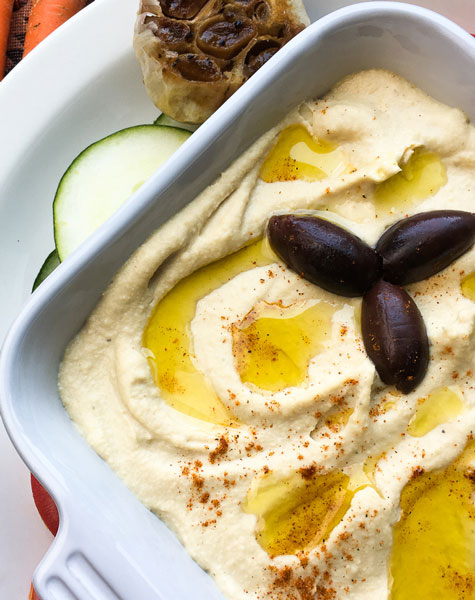
More Greek Foods to Explore
You don't have to prepare every food during your Greece study. Choose a few additional dishes to research, find on a restaurant menu or add to your World Studies notebook. Some are strongly associated with Greece, while others have related versions in neighboring food traditions.
Gyros, souvlaki and baklava may be familiar Greek restaurant foods, but they represent only a small part of Greek cooking. Look for vegetable dishes, bean dishes, soups, breads, savory pies, seafood and regional specialties to get a broader picture of what people cook and eat.
Extend Your Greek Cooking Lesson
Use these activities to turn a recipe into a larger geography, culture or food-science lesson.
Instead of preparing one large recipe, choose several small foods for a tasting activity. Try pita, tzatziki, vegetables, olives, feta and a small serving of another Greek dish. Have kids record which ingredients they recognize and which foods are new to them.
When two countries prepare foods that look similar, don't assume one recipe belongs exclusively to one place. Compare the ingredients, names, preparation methods and ways the foods are served. Shared foods can help kids understand how geography, trade, migration and neighboring cultures can influence cooking.
World Studies Notebook
Add Greece to your Cooking Around the World notebook. This is a good place for kids to combine geography, language, food and cooking skills from the lesson.
Include:
- Country: Greece
- Continent: Europe
- Capital: Athens
- The Greek flag
- Greece and its surrounding seas on a map
- One Greek word or phrase
- One ingredient you investigated
- One Greek food you learned about
- A recipe you prepared
- A cooking skill you practiced
- A drawing or photograph of your finished food
Write one sentence explaining how Greece's geography might influence its food. Kids might choose the surrounding seas, mountainous landscape, Mediterranean climate, islands or olive-growing areas as their example.
Continue Your Cooking Around the World Study
Travel to another country through food, or return to the World Cooking hub to choose your next lesson.
Cooking Around the World Curriculum
Continue your Greece study with our Cooking Around the World World Studies Curriculum. Kids can explore geography, culture, food traditions and hands-on cooking while learning about countries and regions around the world.
Use the Greek cooking activities on this page as part of a larger country study, homeschool geography lesson, classroom activity or family Cooking Around the World project.
Do you have an International Recipe or World Studies Fact?
Do you have an International recipe or know a lot about a country we could add to our world studies section? You can create your own page.
Greek Cooking Questions
Greek cooking varies by region, but common ingredients include olive oil, vegetables, beans, grains, herbs, lemons, yogurt and cheeses. Fish and seafood are important in many coastal and island communities, while breads, savory pies, meat dishes and seasonal produce are also part of Greek food traditions.
Tzatziki is a good beginner recipe because kids can measure, mix and grate ingredients without cooking at the stove. Kids can also help assemble Greek-style pitas, mix spanakopita filling, brush and fold phyllo pastry or prepare a marinade for souvlaki. Choose cooking jobs that are appropriate for the child's age and have an adult handle raw meat, sharp knives, grills and hot pans.
Olives, olive oil, lemons, oregano, dill, feta cheese, yogurt, tomatoes, cucumbers, eggplant, zucchini, beans and lentils are useful ingredients to investigate. Kids can taste, smell or examine a few ingredients and then look for them in the recipes they prepare.
Olive trees have been cultivated in Greece for thousands of years. Olive oil is used in many ways, including cooking vegetables and meats, making dressings and marinades, baking and adding flavor to finished dishes.
No. Greece includes mountainous mainland areas, farming regions, long coastlines and many islands. Local ingredients and food traditions can vary from one place to another, so Greek cooking includes many regional and family variations.
Souvlaki generally refers to small pieces of meat cooked on skewers. Gyro refers to meat traditionally cooked on a vertical rotating spit and sliced for serving. Both can be served with pita and similar toppings, which is one reason the names are sometimes confused.
Spanakopita is a Greek savory pie made with spinach, cheese and thin sheets of phyllo pastry. It can be baked as one large pie or folded into smaller individual pieces such as triangles.
No. Baklava is enjoyed in Greece and is also part of food traditions in Türkiye, the Balkans, the Middle East and surrounding areas. Recipes can differ in the nuts, spices, syrup and preparation methods used.
Kids can practice measuring, mixing, marinating, assembling foods and working with ingredients such as yogurt, herbs and phyllo pastry. They can also learn about Greece's geography, language, agriculture and regional food traditions while comparing Greek foods with foods from other countries.
Find Greece in southeastern Europe and locate Athens, the Greek mainland and surrounding seas. Kids can also locate several Greek islands and neighboring countries. As you explore recipes, connect ingredients and foods with Greece's mountains, coastlines, islands, farming areas and Mediterranean climate.
Where Will You Cook Next?
Continue your Cooking Around the World adventure by choosing another country or region. Compare its geography, ingredients and food traditions with what you learned about Greece.
Take Me to Another World Cooking Lesson: Indian Cooking
Back to Kids Cooking Activities
Explore More Cooking Around the World
Get Free Kids Recipe Cards + Cooking Printables
Join Kids Cooking Activities for fun recipes, cooking ideas, and printable resources for kids, families, and classrooms.
Follow Kids Cooking Activities too:





© Debbie Madson, Madson Web Publishing, LLC — All rights reserved.
The material on this site is for educational purposes only.